
- Two groups of players per team Offense (in charge of scoring; 11 players) and defense (in charge of keeping the other team from scoring; 11 players). When one team's offense is on the field, the other team's defense is too.
- Two ways to move the ball Passing (ball in the air) or running (ball in a player's hands). Passing can gain more yards, but it's riskier: it's more likely to lead to an interception and a turnover.
- Only the ball carrier can be tackled Everyone else can only be blocked, which means players can't grab, wrap or pull at them.
Rules Basics
New to the rules? Start with the four basics below, then explore the field, the penalties and what the referee is signaling.
1 Start here: the basics
 Objective
Downs
Objective
Downs
The offense has four downs (essentially four plays) to go 10 yards.
- Make 10 yards in four tries or fewer? The team gets a fresh set of four downs.
- Still short after three tries? The team usually punts on 4th down (a punt is a kick to the opponent without a tee). The other team then starts its own set of downs, going the other way.
How do I know which down it is?
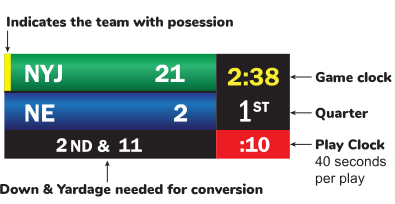
Look at the scoreboard on the screen. Next to the quarter and time left, it shows the down and how many yards the team needs for a first down. For example, 2nd & 11 means it's the 2nd down (out of 4) and the team needs to gain 11 yards for a new 1st down.
 Scoring Methods
- 6TouchdownA player carries or catches the ball across the goal line.
- 3Field GoalThe Kicker kicks the ball through the goal posts.
- 1Extra Point after a touchdownThe kicker kicks the ball between the uprights.
- 22-Point Conversion after a touchdownThe offense carries or passes the ball into the end zone again.
- 2SafetyThe defense forces the other team to down the ball in its own end zone.
Game Clock
When you're watching a football game, it seems that the clock is constantly stopping. Well, it is! This is a game of strategy and strength: the teams need time to think (or rest) and the referees need time to catch up with what is going on.
The clock stops for:
- End of a quarter
- 2 minutes left in a half
- A team calls a timeout (3 per half)
- An incomplete pass
- The ball carrier goes out of bounds
- A player is badly injured
- A penalty is called
- Someone scores
- The officials measure the ball position
- Possession changes (punt, turnover or failed 4th down)
- A fair catch
2 Keep exploring


Did you know?
- Only the player with the ball can be tackled. Everyone else can only be blocked.
- Offensive Tackles aren't actually allowed to tackle. They only block for the player with the ball.
- The yellow first-down line on TV is only on your screen. The players can't see it!
- A coach challenges a call by throwing a red flag. If he's wrong, his team is charged a timeout.
- On a fair catch, the returner waves one hand. Then no one can hit him, but he can't run with the ball either.
- In the NFL, a player who slips without being touched can get up and keep running. In college, the play is over.
- A safety is worth 2 points, and the team that scored it also gets the ball back on a free kick.