Rules Penalties
The most common penalties, grouped by how many yards they cost. The figure next to each one shows the referee's signal.
5 5-yard penalties
-
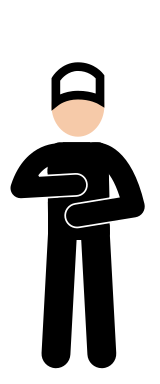
False Start 5 yards
An offensive player on the line moves before the ball is snapped.
-

Offsides 5 yards
Any part of a player's body is beyond his line of scrimmage (or free kick line) when the ball is snapped.
-
Encroachment 5 yards
A player enters the neutral zone and makes contact with an opponent before the ball is snapped.
-

Striking 5 yards
Swinging, clubbing or propelling the arm or forearm to whack an opponent.
10 10-yard penalties
-

Holding 10 yards
A player grabs another player to gain an advantage. Can be called on the offense or the defense.
-
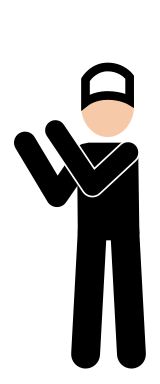
Intentional Grounding 10 yards + loss of down
A quarterback in the pocket who is about to be sacked throws the ball away where none of his players has a realistic chance of catching it.
15 15-yard penalties
-

Clipping 15 yards
An offensive player blocks a defensive player from behind, usually at or below the waist.
-

Unsportsmanlike Conduct 15 yards
After the play is over, a player makes inappropriate contact or gestures, or says something inappropriate to an opponent or official.
-
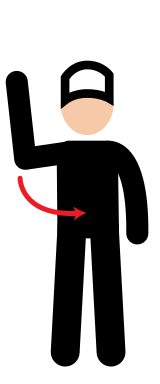
Roughing the Passer 15 yards + automatic first down
A defender makes illegal contact with the quarterback: more than mild contact after he has thrown, or any contact with his head.
! Ball moved to the spot of the foul
-
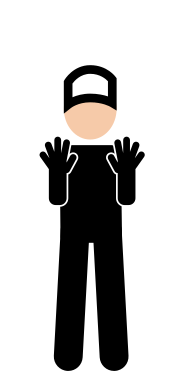
Pass Interference Spot of foul + automatic first down
A player blocks another player's chance to catch a downfield pass before the ball arrives. Can be called on either side, but usually on the defense.
See all referee signals ›
 Which calls can be challenged?
In most circumstances, penalties cannot be challenged by the coaches—they can only challenge rulings on the field (judgement calls). Teams get only two challenges per half, but if a challenge is ruled correct an additional challenge is given. If a team is ruled incorrect on a challenge, the team loses one timeout. The coach shows he is challenging a call when he throws a red flag on the field.
Calls that may be challenged:
- whether a complete pass was made (the receiver had secure possession of the ball)
- whether the ball was a fumble (the receiver did not have secure possession of the ball)
- whether the player with the ball was out of bounds
- whether the player with the ball crossed the goal line for a touchdown
- the placement of the ball on the field (every yard gained is valuable)
- whether the other team has too many men on the field
Once the coach issues his challenge, the referee goes to one of two or three shielded television monitors near the field and looks at the play from all available angles. He has 60 seconds to review it, then must decide. He may:
- overrule and change the call on the field, possibly with other revisions such as resetting the clock;
- confirm the original call, meaning the replay shows it was correct; or
- rule that the original call stands, meaning there wasn't enough visual evidence to confirm or overturn it.